Physician-led guidance
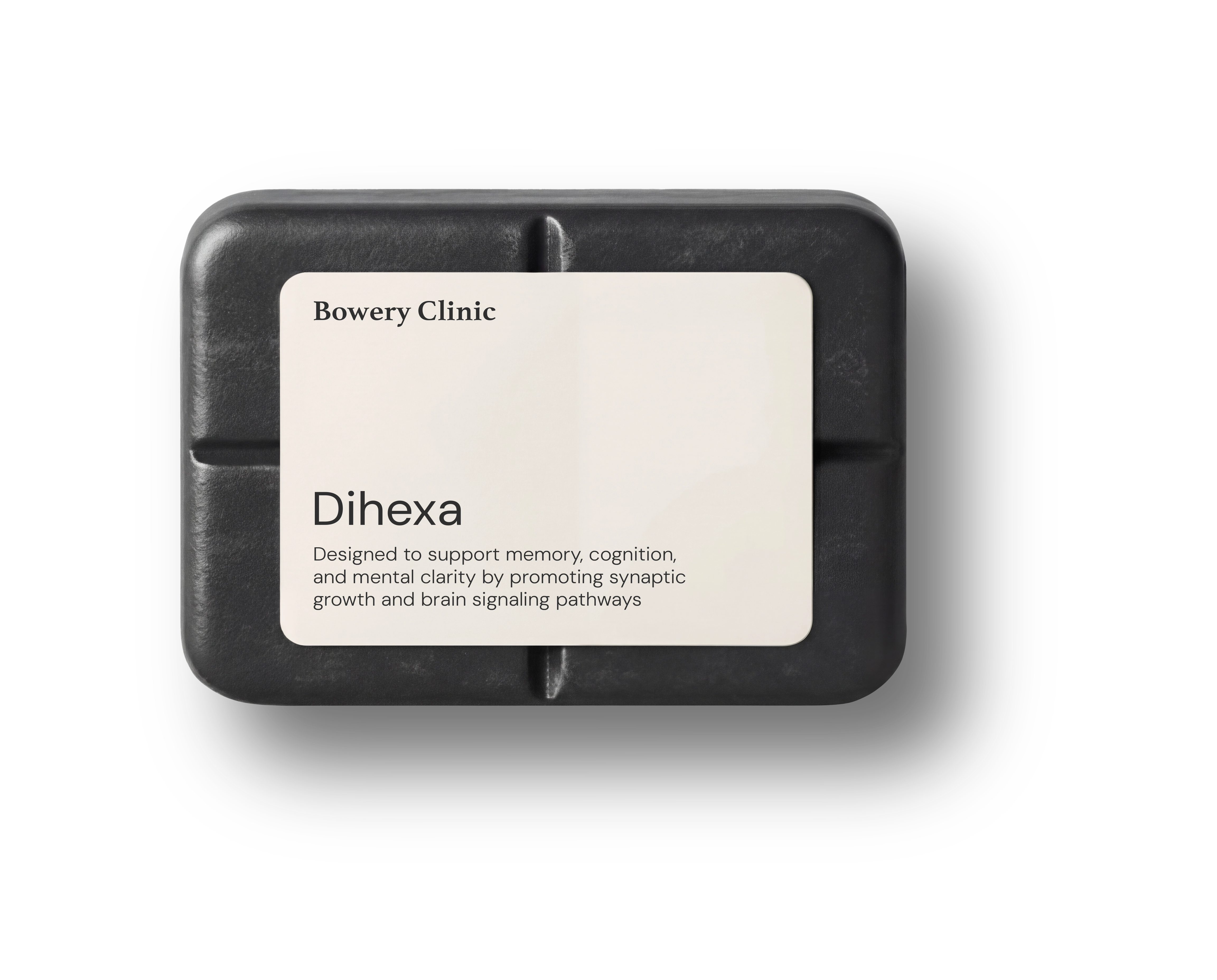
Dihexa
Designed to support memory, cognition, and mental clarity by promoting synaptic growth and brain signaling pathways.
Lasts approximately 30 days
$199
All necessary delivery materials are included with your order, along with clear, step-by-step instructions. Your peptide arrives fully prepared for use, so mixing or reconstitution is not required and syringes are included for vials. There are no additional subscription or shipping fees.
Take the capsule by mouth with water and swallow whole — do not chew or open. For best absorption, take as directed by your provider, ideally at the same time each day. Your cycle length and dosage may change over time based on your goals and your provider’s ongoing evaluation.
Dosage is personalized based on your treatment and physician review. Clear dosing instructions are included with your order, and you’ll have ongoing access to schedule with your physician for support and adjustments throughout treatment.
Licensed Pharmacies
Unlimited Doctor Visits
Premium Quality Care
Fully Online Access
Licensed Pharmacies
Unlimited Doctor Visits
Premium Quality Care
Fully Online Access
Licensed Pharmacies
Unlimited Doctor Visits
Premium Quality Care
Fully Online Access
Licensed Pharmacies
Unlimited Doctor Visits
Premium Quality Care
Fully Online Access
How it works
Start your next chapter with physician-guided care, built for real results.

Step 1
Start with a quick assessment
Share your goals and health background so your care team can tailor your plan from day one, quickly and confidently.

Step 2
Doctor-reviewed and prescribed
Receive a personalized protocol with physician-developed treatments and access to scheduled doctor visits.

Step 3
Delivered to your doorstep
Your prescription is filled by a licensed pharmacy and delivered straight to your home, safely and discreetly.
A better standard of care




The science behind peptides
Discover how each peptide uniquely supports your body's health and performance.
- Enhances synaptic formation and neuronal connectivity - Improves learning & memory performance in Azheimer's disease - Promotes long-term potentiation - Stimulates neuroregeneration - Demonstrates strong oral bioavailability - Non-stimulant congnitive enhancer without dopaminergic or adrenergic activation
Dihexa is a small peptide-derived compound developed from angiotensin IV research. It is designed to cross the blood-brain barrier and has been studied for its interaction with the hepatocyte growth factor (HGF)/c-Met system, a pathway involved in neuronal growth, synapse formation, and cellular repair. In preclinical research, Dihexa has promoted hippocampal spinogenesis and synaptogenesis and has shown procognitive effects in animal models mechanistic study. That is why it is discussed in cognitive-optimization and healthy-aging circles.
Dihexa appears to enhance HGF/c-Met signaling, which is involved in synaptic connectivity and neuronal plasticity. Laboratory and animal work has shown increased synapse formation and improvements in memory-related tasks after exposure to Dihexa or related angiotensin-IV analogs research. Additional preclinical work describes Dihexa as orally active and blood-brain-barrier permeable research review. The goal is generally cognitive wellness—focus, mental performance, or healthy-aging support. Those are not the same as clinically proven cognitive outcomes in humans.
Dihexa requires particularly careful clinician oversight because robust human safety studies are lacking. Its activity around HGF/c-Met growth-factor signaling is biologically significant, and the long-term implications of manipulating that pathway in healthy people are not well defined. Your clinician will review cancer history, neurologic conditions, medications, pregnancy status, and the reason for seeking treatment before considering Dihexa. Patients should report new headaches, neurologic symptoms, mood or sleep changes, gastrointestinal symptoms, or other unexpected effects.
Dihexa does not have an established human effectiveness timeline because clinical efficacy studies are lacking. For a clinician-guided cognitive wellness protocol, changes in focus or mental performance would generally be reassessed over about 4–8 weeks rather than expected after a single dose. If no meaningful benefit is present during the planned cycle, continued use should be reconsidered.
Bowery Clinic peptides are higher-strength and clinically dosed compared to most research facilities that use much lower concentrations. They are compounded by licensed 503A pharmacies with physician oversight and sterile quality standards, prioritizing real therapeutic outcomes over cheaper, unregulated research-grade products, and come fully prepared and ready for use — no mixing or reconstitution needed.
Yes. All pharmacies in our network are fully licensed in the states where they operate and comply with all state board of pharmacy regulations. Unlike many peptide clinics, we partner exclusively with FDA-registered U.S. pharmacies that undergo rigorous evaluation and compliance checks.
Every patient receives treatment plans developed and monitored by licensed providers. This includes safe titration of dosages and ongoing medical oversight tailored to individual needs.
Injections deliver the medication directly into your system. This makes the absorption more consistent and effective. Troches are small dissolvable lozenges that sit in your mouth until they melt, slowly releasing medication through the lining of your cheek or under your tongue.
Explore more peptide treaments

Advancing peptide research through quality, innovation, and scientific excellence.
The statements made within this website have not been evaluated by the US Food and Drug Administration. The products we offer are not intended to diagnose, treat, cure or prevent any disease.
members@boweryclinic.com